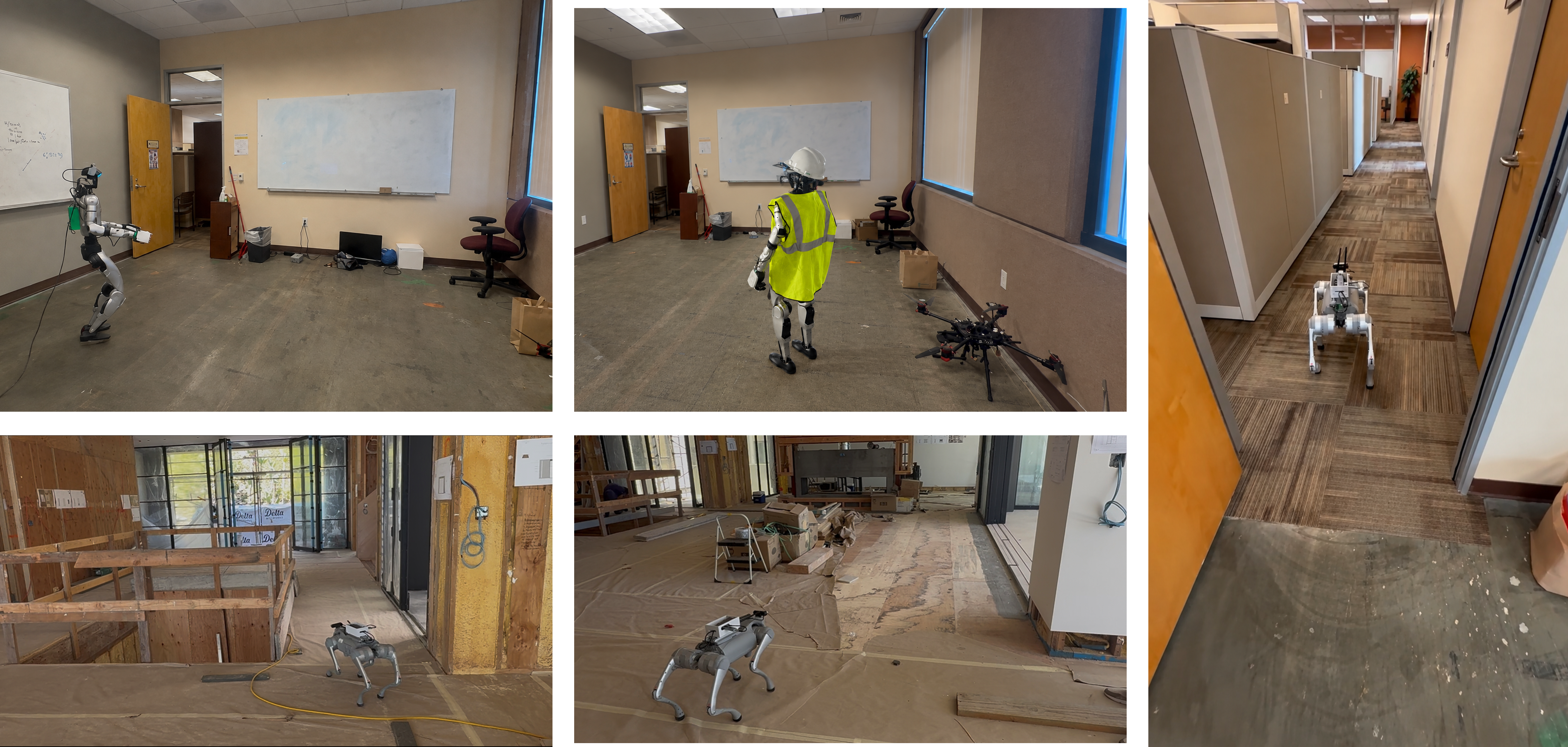
Unitree Go2 quadruped and Unitree G1 humanoid performing navigation queries on a construction site and the office environment.
Scroll or swipe for more →
Abstract
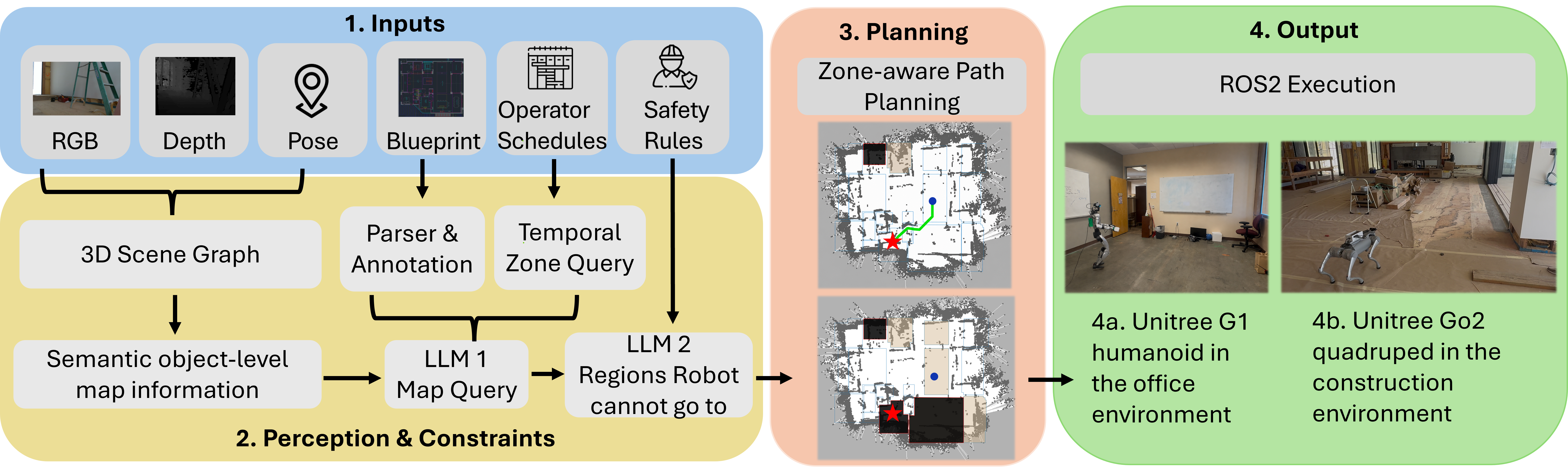
The construction industry faces persistent labor shortages, low productivity that costs the global economy over $1.6 trillion annually, and one of the highest injury rates among major industries. These factors motivate the use of autonomous robots to improve efficiency and worker safety. Existing language-grounded navigation systems, however, rely on semantic scene understanding alone and lack access to construction-specific context such as architectural plans, evolving work schedules, and safety constraints. As a result, they localize permanent building features unreliably and cannot safely navigate active jobsites. We present CORNAV, a blueprint-grounded, schedule-aware navigation framework that operates from 2D CAD drawings and project schedules without requiring a Building Information Model. CORNAV aligns architectural blueprints against hierarchical open-vocabulary scene graphs to ground object queries, converts project schedules into time-varying navigation constraints, and validates requests through an LLM-based safety module that escalates hazardous zones before planning. An A* planner then enforces mandatory exclusion zones while preferentially avoiding higher-risk areas. Across an indoor office and a real construction site, blueprint grounding raises task success from 13.0% to 72.2% over semantic retrieval alone, schedule awareness eliminates all hard-zone violations, and the safety module correctly rejects hazardous requests arising from mislabeled project schedules.
System Overview
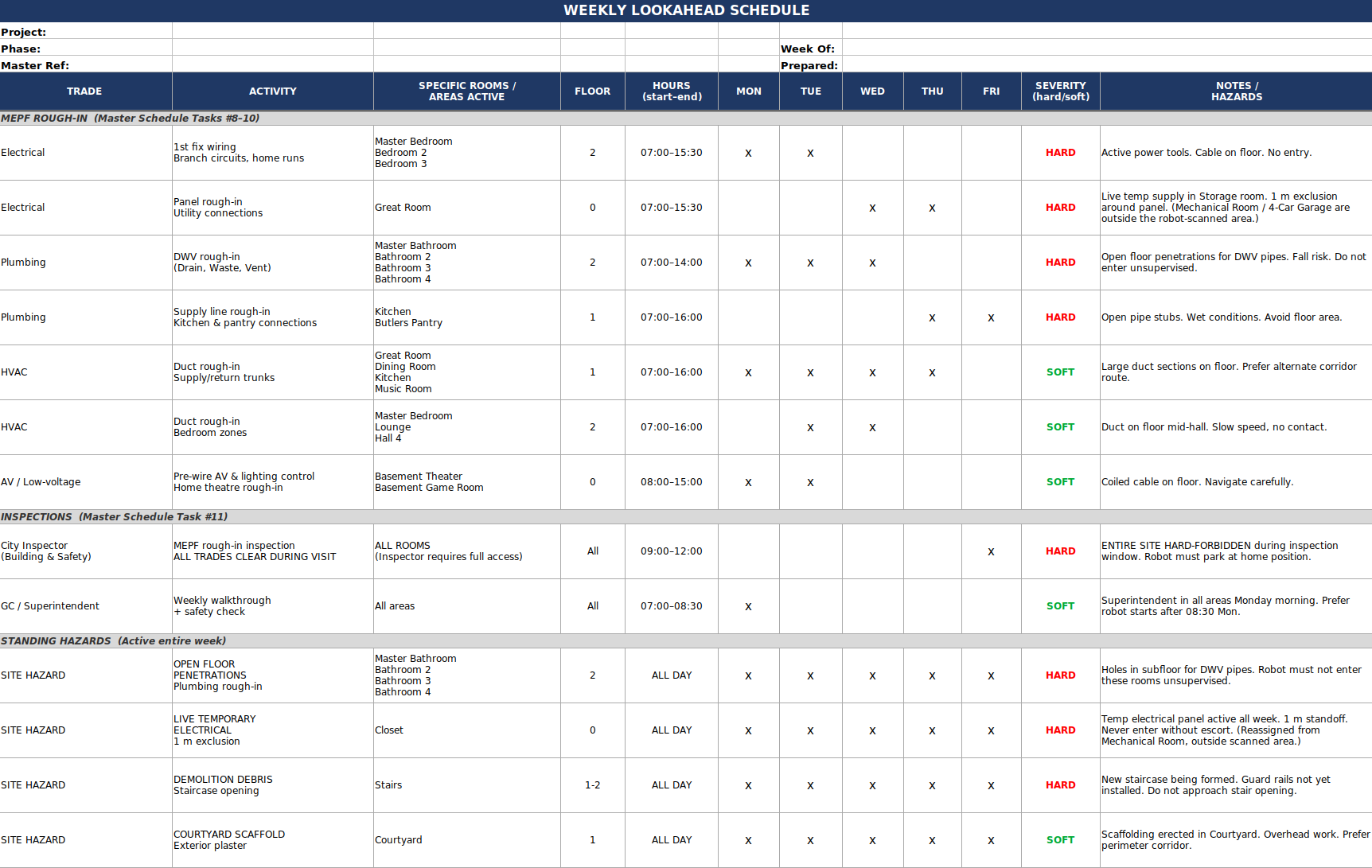
Sample Weekly Lookahead Project Schedule
BibTeX
@misc{anonymous_icra,
  author  = {Anonymous Authors},
  title   = {CORNAV: Construction-Aware Reasoning for Robot Navigation on Active Worksites},
  note    = {Under review at ICRA},
  year    = {2027},
}